Pheromonal Influences On The Sociosexual Behavior Of Men
Copyright ©1997 Athena Institute for Women's Wellness Research, Chester Springs, PA 19425
Poster Abstract Presented to North American Menopause Society Meeting
September 1997, Boston MA
Click here to read the full study with references
Intro from Dr. Cutler:
Below you will find the efficacy study proving that our men's cosmetic fragrance additive, Athena Pheromone 10Xtm, worked to increase the sexual attractiveness to women of the men who wore it according to directions. You should know:
- This sort of study is really science's "gold standard"
- We studied average looking men who were clean shaven. To do this we rejected volunteers who were too handsome, or too unattractive, as well as those with facial hair.
- Each man was measured against his own baseline...the first two weeks he recorded his social experiences.
Finally, please recognize that the scope of the behaviors tested here is broader than what Athena Institute claims for its cosmetic product. Our marketing literature and our advertising makes clear that 10X is not an "aphrodisiac"; it is a topical cosmetic fragrance additive that, used according to our directions, can increase the sexual attractiveness for 3 out of 4 men over 6 weeks. For more information on a gold-standard, double-blind study please click here.
By Winnifred B. Cutler, Ph.D., Erika Friedmann, Ph.D., Norma L. McCoy, Ph.D.
Abstract
This study tested whether synthesized human male pheromones increase the sociosexual behavior of men. Previous data showed such was the case in women. 38 heterosexual men, aged 26-42, completed a 2-week baseline period and 6-week placebo controlled, double-blind trial testing a pheromone "designed to improve the romance in their lives". Each man kept daily behavioral records for 6 sociosexual behaviors Faxing them weekly:
Sexual intercourse
Sleeping next to a romantic partner
Petting/affection/kissing
Informal dates
Formal dates
Self stimulation to ejaculation (masturbation)
Significantly more pheromone than placebo users increased above baseline in
Sexual intercourse and Sleeping next to a romantic partner.
There was a tendency for more pheromone users than placebo users to increase above baseline in
Petting/affection/kissing, and Informal dates.
No significant difference resulted from pheromone use vs. placebo use for
Self stimulation to ejaculation or Formal dates.
A larger proportion of pheromone than placebo users increased in
>=2 of the 5 sociosexual behaviors involving a female partner (58% vs. 19%); and
>=3 of the 5 sociosexual behaviors involving a female partner (41% vs. 9.5%).
Thus, human male pheromones topically applied in aftershave lotion caused a significant increase in male sociosexual behaviors in which a woman's sexual interest plays a role, but not in male masturbation which clearly reflects male sexual interest. We suggest that human male pheromones increased the sexual attractiveness of men to women.
Results
During the 6 experimental weeks, daily calendars showed an average use of the aftershave of 5.82 (± .98) days per week for pheromone users and 5.29 (± 1.24) days per week for placebo users. Usage did not differ significantly between the 2 groups (t<1).
The proportion of subjects in the pheromone and placebo groups who increased over baseline are detailed in Table II.
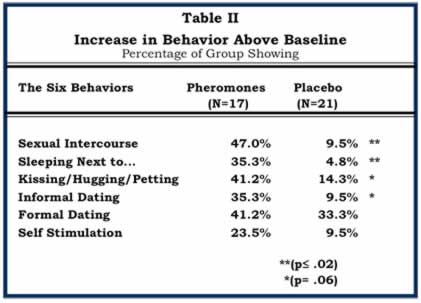
A significantly higher proportion of pheromone users than placebo users showed an increase over baseline for Sexual intercourse and Sleeping next to a romantic partner.
There was a tendency for a greater number of pheromone users to increase above baseline in Petting/affection/kissing and Informal dates.
The proportions of pheromone and placebo users showing an increase over baseline in Self-stimulation to ejaculation and Formal dates did not differ significantly.
A larger proportion of pheromone than placebo users increased over baseline in > (greater than or equal to) 2 (p=.01) and > 3 (p=.02) of the five sociosexual behaviors involving a female partner.
A significantly higher proportion of pheromone (47%) than placebo users (24%) perceived positive results during the 6-week experimental period (Z=5.05, p <.001).
Discussion
In this prospective, double-blind, placebo-controlled study of six discrete sociosexual behaviors, human male pheromones caused a statistically significant and distinct increase in the two most intimate behaviors: sexual intercourse and sleeping with a woman. These are sociosexual behaviors in which the willingness of a female partners plays a major role.
There was a tendency for pheromones to increase the next most intimate behaviors of petting/ affection/kissing and informal dates. Human male pheromones did not cause an increase in those behavior in which a woman does not play a major role...
...Although both pheromone and placebo users had reason to have the same expectations, significantly more pheromone than placebo users showed an increase over baseline in the two most intimate behaviors requiring the willingness and participation of a female partner - but not those in which the partner played a minor role. Thus, it is suggested that human male pheromones, as applied here, increased the sexual attractiveness of men to women in our study.
Learn More about Athena Pheromone 10X for men (used in this published study)
Conclusion: Uses for Topical Pheromone Cosmetic in Sexual Therapy
(Psychiatric Annals Excerpt Pge.58)
Because an increase in sexual attractiveness from the use of a cosmetic pheromone was demonstrated by the recently published study (ARCHIVES OF SEXUAL BEHAVIOR: An Interdisciplinary Research Journal. Plenum Press - New York, London. Vol. 27, No.1, 1998), it is logical to address possible uses and benefits.
In nature, pheromone output appears to crest during the peak years of fertility and declines with passage into the post-fertile years. The frontier of therapeutic applications involving cosmetic pheromone additives has exciting potential.
Some of the possible paths to pursue for topical pheromones in sexual therapy include: A patient adds pheromone to his or her own fragrance to increase his or her partner's sexual interest. In conjunction with psychotherapy, this change in the partner's response is incorporated into the healthy emotional functioning of the patient. Patients with infertility problems -- with or without known pathology -- need a romantic life.
Studies reviewed above have shown that couples trying to conceive a viable pregnancy benefit from regular weekly sexual intercourse because the behavior increases the likelihood of a fertile-type cycle in the woman. Intrusive infertility treatments usually compromise some of the romance between the couple.
*** Because cosmetic pheromones can promote or restore romance, they may serve as a useful adjunct to both the psychologic and the reproductive endocrine treatments. Sex-attractant type pheromone cosmetics can be incorporated into the user's daily routines to increase the chances for therapeutic benefits.
End of Excerpt
A portion of the profits from our book and pheromone sales helps to fund Athena's on-going research.
*For More Research on Male Sexuality click here
Athena has wisdom to help men get more romantic attention from women. Stop by our Men's Corner.