The Impact of Hysterectomy on Sexual Life of Women

A Poster Presentation by Athena Institute for Women's Wellness, Inc.
at the American College of Obstetricians and Gynecologists 2001 meeting.
Read more about Hysterectomy and Sexuality and pheromones and books from Athena Institute
Authors:
Winnifred B. Cutler, Ph.D., President and Founder, Athena Institute for Women's Wellness
Norma L. McCoy, Ph.D.,Professor of Psychology, San Francisco State University, SFO, CA
Millicent G. Zacher M.Ed.,D.O., F.A.C.O.G.,Director, Div of Reproductive Endocrinology, Albert Einstein Medical Center, Phila. PA
Elizabeth Genovese M.D.,Medical Director, IMX, Bala Cynwyd, PA and
Erika Friedman, Ph.D. Professor of Biology, Chair, Dept Health and Nutrition Sciences, Brooklyn College, Brooklyn, NY
May, 2001. The American College of Obstetricians and Gynecologists (ACOG) held its 49th Annual Clinical Meeting (ACM) in Chicago, IL.,at the Hilton Hotel. The meeting began Monday, April 30 and ran through Wednesday, May 2. ACOG is a national medical organization which represents over 40,000 obstetricians and gynecologists throughout the United States. ACOG’s ACM is one of the largest gatherings of women’s health care practitioners, drawing thousands of physicians, experts, poster exhibitors, researchers, and guests
Abstract
Objective:
To analyze the impact of hysterectomy on frequency and quality of sexual life.
Design:
Questionnaire results from 4 groups were compared: 155 women's wellness patients (132 intact; 23 post hysterectomy) were compared to 37 with myomata uteri and recently published (JAMA) reference data of hysterectomy patients pre and post op.
Results:
1) Women scheduled for hysterectomy showed the lowest incidence of regular sexual activity (31%) & the lowest incidence of frequent orgasms during coitus (46%) compared to all other groups.
2) Table 4 shows that the impact of clitoral stimulation on sexual arousal and orgasm was not compromised by hysterectomy while a significant reduction in vaginal sensation and in deep (cervical) sources of arousal and orgasm is reported.
Conclusions:
1) Sexual life is suppressed in women scheduled for hysterectomy. The current practice of using sex life just prior to surgery as a baseline should be avoided.
2) Hysterectomy impaired genital sensations vaginally and at the cervical region.
3) Myomata uteri were associated with enhanced genital sensations both vaginally and cervically.
Background and Methods
Background
Authors of several recent studies have concluded that hysterectomy improves the sexual life of women1,2. Such studies have compared data of the reported sexual behavior occurring in the few weeks before surgery to reports gathered 2 years after surgery. Such conclusions may be incorrect due to an erroneously chosen baseline period. We hypothesize that the elevation in several measures of sexual behavior 2 years after--compared to 30 days before--surgery1,2 provides evidence that the immediate presurgical period is a time of suppressed sexual life.
Sexual stimulation of the clitoris is well established as a trigger for orgasm for most women3. Vaginal stimulation also has been reported to trigger orgasmic inevitability if the rhythm and pressure are individualized4.
Work in rats has established a significant role of cervical stimulation in triggering hypothalamic-pituitary neural pathways that trigger GNRH release. Work in spinal-injured women with intact uteri has demonstrated that cervical and vaginal stimulation applied differentially triggered disparate orgasmic perceptions in these women5.
Our own questionnaire studies of populations of intact well women and those with myomata uteri confirmed that women experience differences between clitoral, vaginal and cervical sources of sexual stimulation6.
We present evidence to show how a simple error of logic has lead to misleading conclusions.
Methods
We arrayed the most widely cited pre and post hysterectomy data from JAMA1 and compared them to our samples of well women, and women with myomata uteri.
Consecutive patients undergoing comprehensive executive physical exams were asked to complete medical history forms, extensive questionnaires on genitourinary experience of incontinence and sexual response including coital and orgasmic frequency. Women using either oral contraceptives or Prozac were excluded from our final data analysis because of recent studies showing sexual response deficiencies in these groups8,9. Informed consent was obtained to use their data. An unaffiliated gynecologist interested in contributing a separate pool of data provided the same questionnaires to 37 patients whom she had diagnosed with myomata uteri.
Results
Table 1: Proportion of Women Reporting They Are Sexually Active
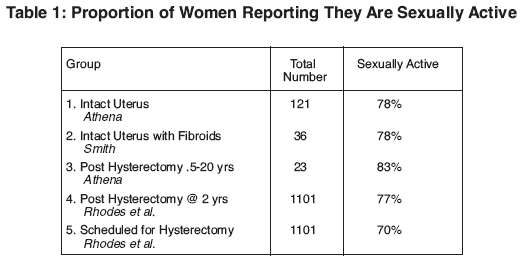
A significantly lower proportion of women are sexually active before their hysterectomy than two years later1.
Table 2: Proportion of Women Reporting Frequent Sexual Activity
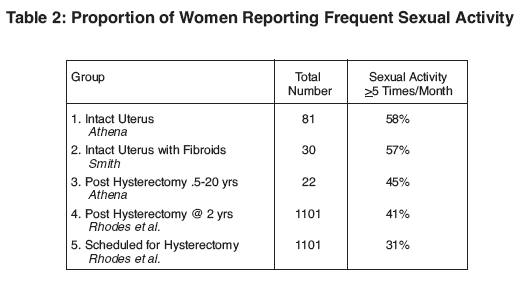
Comparison of women reporting frequent sexual activity was tested for Groups 1,2,3,and 5. X2(3,N = 1234) = 33.87, p <. 005.
Because Groups 4 and 5 are the same women, they are not independent, and therefore group 4 was excluded from comparisons.
A significantly lower proportion of women are FREQUENTLY sexually active before their hysterectomy than themselves two years later1, or than women with fibroid tumors (X2(3,N = 1234) = 9.0, p < .025) or women with an intact uterus X2(3,N = 1234) = 25.5, p < .0005.
Table 3: Proportion of Women Reporting Frequent Orgasm
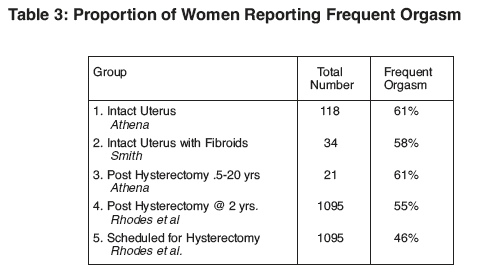
Comparison of women reporting frequent orgasm was tested for Groups 1,2,3,and 5. X2(3,N = 1268) = 13.76, p < .005.
A significantly lower proportion of women are frequently orgasmic before their hysterectomy than intact well women (X2(3,N = 1268) = 10.19, p < .01) or than themselves two years after hysterectomy1.
Table 4: Frequent Contribution to Orgasm by Site
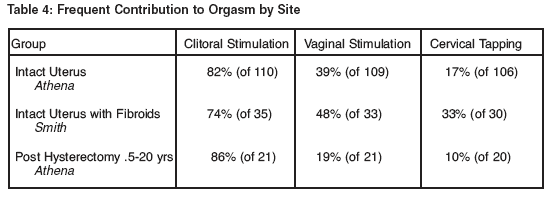
Hysterectomy appears to compromise sexual sensitivity at both the vaginal and cervical sites. Comparison of the frequency of women reporting that vaginal stimulation frequently contributed to orgasm revealed differences among the three groups of patients.Women with fibroid tumors appear to experience a heightened vaginal sensitivity. X2(2,N = 163) = 4.08, p < .07.
Similar analysis for cervical sensitivity also revealed a significant difference X2(2,N = 156) = 5.29, p < .05.
Conclusions and Refs
Conclusions
1) Sexual life is apparently suppressed in women scheduled for hysterectomy. Our data show that not only are women less likely to engage in frequent sexual activity before hysterectomy, but when they do have sexual relations they are less likely to experience orgasm.
2) In women who consent to hysterectomy, a combination of unstudied factors (e.g. pain, bleeding, fear of surgery) apparently combine to reduce their sexual activity.
3) The current practice1,2 of comparing immediate pre-surgery baselines of reduced sexual activity with data collected 1 to 2 year post surgery gives rise to an inherently erroneous conclusion.
4) Future outcome studies after hysterectomy must correct the design errors of previous research. While a woman's prior healthy sexual life history would provide an ideal baseline, such data from distant recall have questionable validity. Hence a valid presurgical baseline is practically impossible to obtain.
5) Future studies of sexual life should compare women after healing from hysterectomy to groups of women with comparable conditions who have not undergone reproductive surgery. Because both groups could provide prospective current information of relatively healthy patterns of sexual behavior, such measures could explore further the effect of hysterectomy on sexual life of women.
6) Hysterectomy does not seem to impair clitoral sensation but does result in reports of reduced vaginal and cervical sensation
7) Women undergoing hysterectomy because of myomata uteri, should be told that the surgery may reduce their genital sensitivity since this condition is associated with enhanced genital sensitivity
References
1. Rhodes JC, Kjerulff KH, Langenberg PW, Guzinski GM (1999) Hysterectomy and sexual functioning. JAMA 282:1934-1941
2. Carlson KJ, Miller BA, Fowler FJ (1994) The Maine Women'sHealth Study: I. Outcomes of hysterectomy. Obstet Gynecol 83:556-65.
3. Master WH and Johnson VE (1966) Human Sexual Response Little, Brown, Boston
4. Alzate H (1985) Vaginal eroticism: a replication study. ArchSexBehav 14:529-537. and for example, Alzate H (1985) Vaginal eroticism and female orgasm: a current appraisal. Journal of Sex and Marital Therapy 11:271-284.
5. Komisaruk B, Whipple B (1986) Vaginal stimulation - produced analgesia in rats and women. Annals NY Acad. Sciences 467:30-39. and
Komisaruk BR, Gerdes C, Whipple B (1997) Complete spinal cord injury does not block perceptual responses to genital self stimulation in women. Archives of Neurology 54:1513-1520.
6. Cutler WB, McCoy NL, Friedmann E, Genovese-Stone E, Zacher MJ (2000) Sexual response in women. ObstetGyncol 95:4(Supplement) April 2000, 198.
7. Cutler WB, Friedmann E, Genovese-Stone E, and Felmet K (1992) Urinary stress incontinence: a pervasive problem among well women. J Wmns Health Vol 1:259-266.
8. McCoy NL and Matyas JR (1996) Oral contraceptives and sexuality in university women. ArchSexBehav 25:73-90.
9. PROZAC (fluoxetine HCL) prescribing information by Dista/Eli Lilly, pp. 859-863, PHYSICIANS DESK REFERENCE 52nd Ed (1998), Medical Economics Company, Inc. Montvale, NJ 07645.
RELATED INFORMATION ON ACOG: Visit www.acog.org
"My research has consistently focused on what behavior a woman can engage in to increase her power, well-being, and vitality."
---Winnifred B. Cutler, Ph.D.
A portion of the profits from our book and pheromone sales helps to fund Athena's on-going research.