Sociosexual Behavior in Healthy Women
Significant Effects of Reproductive Stage and Cohabiting Status

APRIL 2003 . The American College of Obstetricians and Gynecologists (ACOG) held its Annual Clinical Meeting (ACM) in New Oreans, LA.
Norma McCoy Ph.D., San Francisco State University
Joan Friebely Ed.D., Harvard University
ACOG is a national medical organization which represents over 40,000 obstetricians and gynecologists throughout the United States. ACOG’s ACM is one of the largest gatherings of women’s health care practitioners, drawing thousands of physicians, experts, poster exhibitors, researchers, and guests.
*Please click on bold print within text below for details and/or studies in full.
Learn more about pheromones and books from Athena Institute
Abstract
Sociosexual behavior of two groups of healthy women has recently been examined using daily behavioral calendars. These placebo-controlled studies tested the influence of synthesized pheromone fragrance additives on sexual intercourse, sleeping next to a romantic partner, petting/affection/kissing, masturbation, and formal prescheduled dates.
For this report, we analyzed the baseline records only from these 2 studies (recorded before the experimental period began). Results showed comparative decrements in postmenopausal women that are new to the literature.
Subjects/Methods: 36 non-cohabiting San Francisco women Mage=27 commuting to college1 and 44 (32 non-cohabiting) highly educated postmenopausal women in Boston2 M age=57. All wanted "to increase the romance in their lives" and provided >2 weeks of daily baseline records transmitted weekly to researchers prior to the experimental phase. Average weekly frequency of each sociosexual behavior was compared between groups using t-tests.
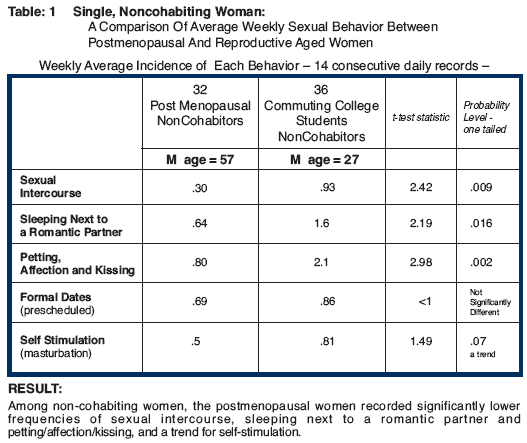
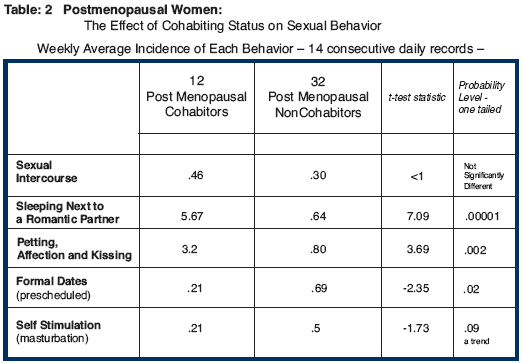
Results: Among non-cohabiting subjects, the younger group recorded more sexual intercourse (p<. 01), sleeping next to a romantic partner (p<.02), petting/kissing/affection (p<.01), and masturbation (p<.07) than the postmenopausal group but no differences in frequency of formal dates. Among postmenopausal subjects, there were no significant differences in sexual intercourse, between cohabiting and non-cohabiting women but cohabiting subjects did record more sleeping next to a romantic partner (p<.01), petting/affection/kissing (p<.01), and fewer formal dates (p<.02] than non cohabiting subjects. Masturbation was not significantly different for the 2 age groups of non-cohabiting women but among postmenopausal subjects there was a trend for lower frequency (p=.09) among women who were cohabiting and a similar trend (p=.07) for lower frequency in older vs. younger noncohabitors.
Conclusion: Among postmenopausal women, those cohabiting recorded a significantly higher frequency of intimate sociosexual behavior than those non-cohabiting. Compared to younger non-cohabiting women, non-cohabiting postmenopausal women experienced less petting/kissing/ affection, sleeping with a partner, and sexual intercourse.
Because affectionate romantic contact increases well being, and many postmenopausal women are not cohabiting, these deficiencies should be considered by practitioners in the context of wellness.
Background and Methods
Background
While it is generally recognized that postmenopausal women experience declines in frequency of sexual intercourse the entire Medline database (1966-2003) revealed no published data of daily records of other forms of sexual and romantic behavior that contribute to well being in women.
Methods
A comparison between postmenopausal and reproductive aged women became possible after 2 double blind placebo controlled trials of a sex attractant pheromone were completed1,2. Criteria for both sets of research subjects included they be in self-reported good health and exclusively heterosexual. All subjects entered the study "to test a pheromone designed to increase the romance in her life". Each subject recorded sociosexual behavior daily and turned in behavioral calendars weekly.
Subjects recruited via published advertisements or classroom announcements attended an initial intake interview at which screening was completed, the study protocol and guidelines reviewed, and they were provided weekly behavioral calendars for FAXing (see Figure).
Each subject provided his or her own preferred alcohol based fragrance. Specific behaviors were described and recorded daily on calendars which were FAXed weekly to the researcher.
The behaviors were:
• Petting, affection/kissing
• Formal dates (pre-arranged)
• Informal dates (not arranged before the day)
• Sleeping next to a romantic partner
• Sexual Intercourse
• Male approaches
• Self Stimulation of genitals; masturbationWe compared the baseline sociosexual behavior of non- cohabiting, highly educated, postmenopausal women to day students commuting to college at San Francisco State University where none were using an oral contraceptive and all were regularly menstruating. We then studied the postmenopausal data to compare those women who were cohabiting to those who were not.
Table 1 : Single, Noncohabiting Woman:
A Comparison Of Average Weekly Sexual Behavior Between
Postmenopausal And Reproductive Aged Women
Results
Among non-cohabiting women, the postmenopausal women recorded significantly lower frequencies of sexual intercourse, sleeping next to a romantic partner and petting/affection/kissing, and a trend for self-stimulation.
Table 2: Postmenopausal Women:
The Effect of Cohabiting Status on Sexual Behavior
Conclusion and References
Conclusion
Postmenopausal women seeking to increase the romance in their lives are at a deficit compared with similarly intentioned reproductive aged women.
Among postmenopausal women, those cohabiting recorded a significantly higher frequency of intimate sociosexual behavior than those not cohabiting. Compared to younger non-cohabiting women, non-cohabiting postmenopausal women experienced less petting/kissing/affection, sleeping with a partner, and sexual intercourse.
Because affectionate romantic contact increases well being, and many postmenopausal women are not cohabiting, these deficiencies should be considered by practitioners in the context of wellness.
References:
1 McCoy NL, Pitino L. Pheromonal influences on sociosexual behavior in women. Physiology and Behavior 2002; 75(3):367-375.
2 Friebely J and Rako S. Influence of synthesized pheromones on frequency of post menopausal women’s sociosexual behaviors. Poster Session Society for Behavioral Medicine. April 6, 2002.
The scientific method; the design of the research study leading to peer-reviewed publication.
RELATED INFORMATION ON ACOG: Visit www.acog.org
" My research has consistently focused on what behavior a woman can engage in to increase her power, well-being, vitality."
---Winnifred B. Cutler, Ph.D.
A portion of the profits from our book and pheromone sales helps to fund Athena's on-going research.